


Car Sale Contract Switzerland – free PDF template
Selling a car privately in Switzerland is straightforward, but the rules are not the ones you know from the UK, the US or the EU. Number plates stay with you. The seller handles deregistration. And a warranty exclusion only holds if you have been honest about the faults. Here is a contract written for Swiss conditions, and an explanation of why each clause is in it.
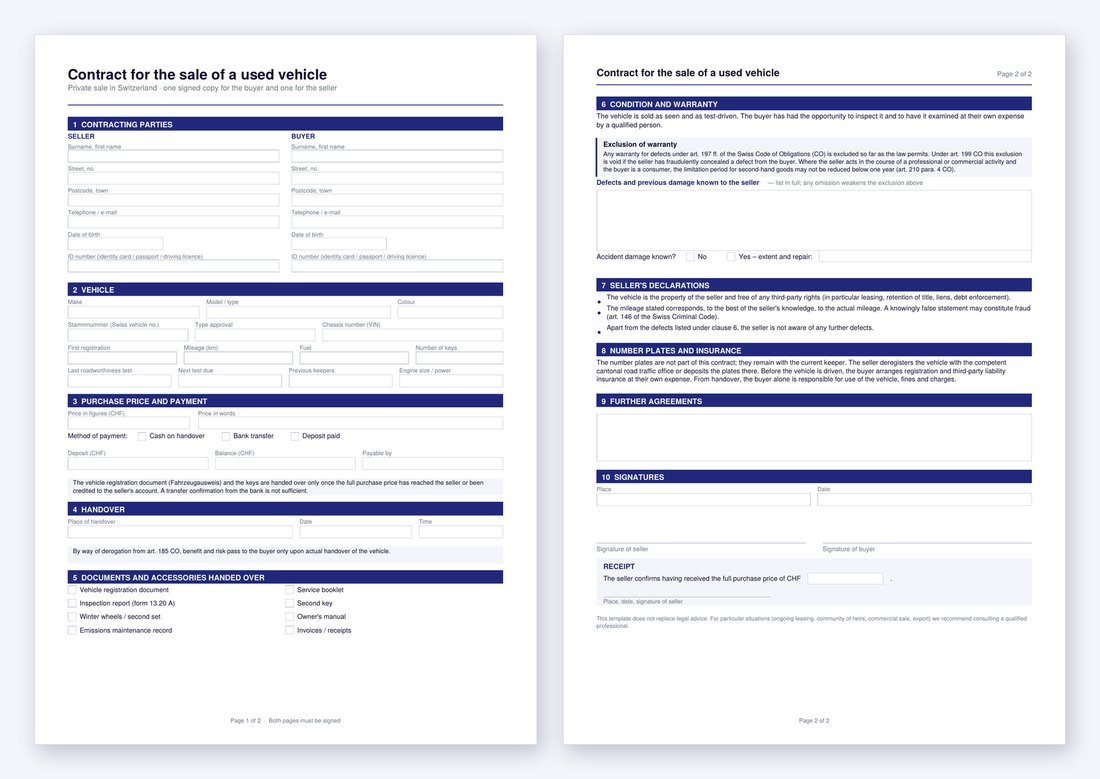
Download the contract
Fillable PDF for your computer, or print and complete by hand · 2 pages · A4 · free
Download the PDFNo sign-up, no email address, no newsletter. The file contains form fields, so you can complete it on screen and print two copies, or print it blank and fill it in by hand.
Leaving Switzerland? Start here
Most people who need this page in English are leaving the country, and that changes the order of operations. Two things catch people out.
First, you cannot simply hand the plates to the buyer and fly home. The vehicle stays registered to you until it is formally deregistered or the plates are surrendered. Fines, parking charges and, in the worst case, liability questions keep arriving at your last known address. Deregister before you leave, and keep the confirmation.
Second, your insurance and road tax refunds depend on that deregistration date, not on the date you sold the car. If you leave the country with the car sold but still registered, you lose the refund and keep the liability.
A practical sequence: agree the sale and sign the contract · receive the money · hand over the vehicle, the Fahrzeugausweis and the keys · surrender or deposit the plates at the cantonal road traffic office · notify your insurer · claim the road tax refund. Only then close your Swiss bank account, not before — the refunds need somewhere to land.
Why a written contract matters, even between friends
In Switzerland a sales contract is valid even if it is only spoken. The problem is not validity, it is proof. If the buyer calls three weeks later because the clutch is slipping, it is one person’s word against the other’s — on exactly the points that matter: what was said about the condition, whether the warranty was excluded, whether the previous damage was disclosed.
What a Swiss car sale contract has to contain
The fields below are all in the template. The ones that matter most are those that identify the vehicle unambiguously — that is where home-made contracts usually fall down.
| Field | Why it is needed |
|---|---|
| Stammnummer | The Swiss vehicle identifier, shown at item 1 of the Fahrzeugausweis. It stays with the vehicle for life, through changes of keeper and new plates. This is the number the road traffic office works from — not the plate number. |
| Chassis number (VIN) | The 17-character international number. Record both: the Stammnummer governs in Switzerland, the VIN is what insurers, importers and exporters ask for. |
| Type approval | Also on the Fahrzeugausweis; identifies the exact version. Prevents arguments about which engine was sold. |
| Mileage | With the date it was read. See the separate section below. |
| Last roadworthiness test (MFK) | The date of the last passed inspection. A recently tested car is worth more, and the buyer knows when the next one falls due. |
| Handover: place, date, time | The moment from which the buyer is responsible for the vehicle. |
| Known defects | The single most important line in the contract. See below. |
“Sold as seen” — the clause that does not always hold
Almost every template contains wording along the lines of “the vehicle is sold with all warranty excluded”. Many sellers assume that settles it. It only partly does, and three provisions are worth knowing.
Art. 197 CO — the statutory warranty
The seller is liable both for promised qualities and for defects that remove or materially reduce the item’s value or its fitness for the intended use. This liability applies automatically, even if the contract says nothing about it.
Paragraph 2 of the same article is the decisive one: the seller is liable “even if he was unaware of the defects”. So you are liable for the corrosion behind the wheel arch you never knew about — for two years. That is precisely why every serious template carries a warranty exclusion. Between private individuals, this liability may be excluded.
Art. 199 CO — the limit of the exclusion
The exclusion is void if the seller has fraudulently concealed a defect from the buyer. This is not a theoretical restriction. Someone who knows the gearbox crunches when cold and does not mention it cannot later rely on “sold as seen”. The exclusion clause protects you from what you did not know, not from what you withheld.
Art. 210 para. 4 CO — if you are selling commercially
A clause shortening the limitation period is void where three conditions are met cumulatively: the period is reduced below two years — or below one year for second-hand goods; the item is intended for the buyer’s personal or family use; and the seller is acting in the course of a professional or commercial activity. For a purely private sale, this restriction does not apply.
What this means in practice: the warranty exclusion only works alongside an honest list of defects. The more completely you write down what you know, the more robust the exclusion becomes for everything else. It sounds contradictory, but it is the heart of the matter — and the reason the “known defects” box in our template is so large.
What belongs in the defects list
From experience: a stone chip in the windscreen, corrosion on the wheel arches or sills, air conditioning that no longer cools, a warning light that stays on after starting, an oil leak, warped brake discs, a failed window motor, a dent or scratch longer than 10 cm, a panel replaced after an accident. Write it down, even though it lowers the price. Three hundred francs off is cheaper than a legal claim.
Mileage: the entry with criminal consequences
Record the reading at handover, not the one from the test drive. A knowingly false figure is not negotiating room — it can constitute fraud under art. 146 of the Swiss Criminal Code, where someone acting with intent to gain deceives another and causes them financial loss.
If you cannot vouch for the mileage across the whole period you owned the car — because you bought it with an unclear history yourself — write exactly that into the contract: “Mileage as displayed; mileage prior to acquisition by the seller on [date] cannot be verified.” That one line is more honest, and legally cleaner, than an assurance you cannot stand behind.
Number plates and insurance: the Swiss difference
This is the point people from almost every other country get wrong. In Switzerland, number plates belong to the keeper, not to the vehicle. They are not sold with the car. After handover you have two options:
- Surrender the plates — the vehicle is taken out of circulation, the insurance is suspended and the road tax is refunded pro rata.
- Deposit the plates — useful if you are registering another vehicle within a month and want to keep your number. Deposit rules vary by canton and there is usually a fee.
Both are handled by the road traffic office of your canton of residence — the Strassenverkehrsamt in German-speaking cantons, the service des automobiles in French-speaking ones, the sezione della circolazione in Ticino.
Important for the buyer: the car cannot be driven without registration and third-party liability insurance in their own name. A buyer who wants to drive it away needs day plates or a transporter. Agree in the contract who arranges this.
Payment: the most common and most expensive mistake
The rule is simple and broken constantly: the Fahrzeugausweis and the keys do not leave your hands until the money is with you. Not when the buyer shows a transfer confirmation on their phone. Not when a payment confirmation arrives by email. Only when the amount is credited to the account, or the cash has been counted.
For larger cash amounts, arrange the handover at your bank counter. The money is checked and paid in immediately. That is not distrust, it is simply sensible at four and five figures — a serious buyer will not object.
Page 2 of the template contains a receipt. Only sign it once you actually have the money. It is your proof towards the buyer and, at the same time, theirs towards you.
Private sale or sell to a dealer?
The contract above is written for private sales. We buy cars ourselves, which will not be glossed over here — so the comparison runs in both directions:
| Private sale | Sale to a dealer | |
|---|---|---|
| Price | Higher — typically 10 to 20 % above the dealer purchase price | Lower, but firm and immediate |
| Time required | Listing, photos, enquiries, viewings, test drives — realistically three to eight weeks | One appointment |
| Warranty | Can be excluded, but only effective with a complete defects list | Not your concern — the dealer takes the car as it stands |
| Payment risk | Yours | None |
| Makes sense for | Well-kept cars with a valid MFK and service history | Cars without MFK, with faults, high mileage, or when you are on a deadline |
If your car is in good order, recently tested and you have time, a private sale pays more. If the MFK has expired, there are faults, or you have a flight booked, a private sale rarely works out — certainly not once you count your own hours.
Frequently asked questions
Does a car sale contract have to be in writing in Switzerland?
No. A contract for the sale of a vehicle is valid even when agreed orally and is subject to no particular form. Writing is a question of proof, not of validity — but in a dispute, proof is the whole question.
How many copies are needed?
Two, signed by both parties, one each for buyer and seller. No notarisation is required.
Is a warranty exclusion valid between private individuals?
Yes. Under art. 199 CO it is void, however, to the extent the seller fraudulently concealed a defect. Where the seller acts commercially and the buyer is a consumer, the limitation period for second-hand goods cannot be reduced below one year (art. 210 para. 4 CO).
What happens to the number plates?
They stay with the seller. In Switzerland plates belong to the keeper, not the vehicle. After handover you surrender them at the road traffic office or deposit them there. The buyer registers the vehicle in their own name.
Do I get the road tax back?
Yes, pro rata for the remaining period, once the vehicle is out of circulation. The process differs by canton: some offices refund automatically, others only on request. The same applies to your third-party liability premium.
I am leaving Switzerland. What is the deadline?
There is no single national deadline, but deregister before you depart rather than after. Once you have left, dealing with a cantonal office from abroad is slow, refunds may be forfeited, and the vehicle remains your responsibility in the meantime. Keep the deregistration confirmation.
Can I sell a car that is still on a leasing contract?
Not without further steps. The vehicle belongs to the leasing company, not to you. You first need the settlement figure and the lessor’s consent. Normally the buyer pays the settlement amount directly to the leasing company and only the difference comes to you. This template does not cover that case.
May I adapt this template?
Yes, use and modify it freely, including commercially. It does not replace legal advice. For leasing, communities of heirs, export or commercial sales to consumers, we recommend consulting a qualified professional.
Short on time before you leave?
We buy used cars across Switzerland — with or without a valid MFK, including cars with faults or high mileage. You get an offer, we handle the deregistration with the road traffic office, and payment is made at handover.
HeyAuto – a family business since 2009 · Bernstrasse 51A, 3114 Wichtrach BE · +41 77 462 87 19 · info@heyauto.ch